Our legacy · Aliabad, Hunza · 1980–2000
Before us, there was our father on the Baltoro
Muhammad Ghori spent twenty seasons guiding travellers to K2, Broad Peak and the great glaciers of the Karakoram. These are his photographs.
Our father, Muhammad Ghori, is from Aliabad in central Hunza. From 1980 to 2000 he guided foreign trekkers and climbers through the Karakoram: up the Baltoro Glacier to Concordia, beneath K2 and Broad Peak, and across glaciers most of the world only knew from expedition books.
He kept the photographs. A box of prints, some sharp and some faded, a few still carrying the orange date stamps of the cameras his guests carried. In October 2026 we scanned them and put them here, because they are the reason Hunza & Beyond exists.
- From
- Aliabad, Hunza
- Guiding years
- 1980–2000
- Home ground
- K2, Broad Peak & the Baltoro
- Today
- Run by his two sons
A guide from Aliabad
Guiding in Gilgit-Baltistan in the 1980s was a trade learned on the trail, not in a classroom. A guide read the weather and the glaciers, kept a team of porters fed, paid and on side, translated between villages and visitors, and made the calls that brought everyone home. Our father did that work for twenty seasons.
The Karakoram Highway had only recently been completed, and in 1986 the Khunjerab Pass opened to tourists, linking Hunza with China and drawing a new wave of travellers north. For the giants of Baltistan the journey was still long: days on the road to Skardu, then a walk up the Braldu valley past Askole before the Baltoro Glacier even began.
Those journeys are what this page is about. The photographs below follow the shape of a trip from that era, from the road in to the high camps, and you can open any of them full size.
Chapter one
The road in
Before the trek came the journey: errands and permits in the city, long days on the road, glacial rivers crossed by cable trolley, and rest stops in the shade of boulders.
Bare feet and calligraphy outside a mosque: the city days of permits and shopping before an expedition headed north. Before many of today's bridges, a steel cable and a wooden box were how you crossed a glacial river. Sheltering under a rock overhang on the walk in, sharing the shade with men and children from the nearest village. A trekking group and village children outside a stone and timber house, rucksacks packed for the trail. A trekking group, and one curious goat, on a stony river bed deep in the valleys. Pine forest, a grey river of glacier ice below and a small group of trekkers. The camera stamped it 22 September 1998.
Chapter two
Under K2
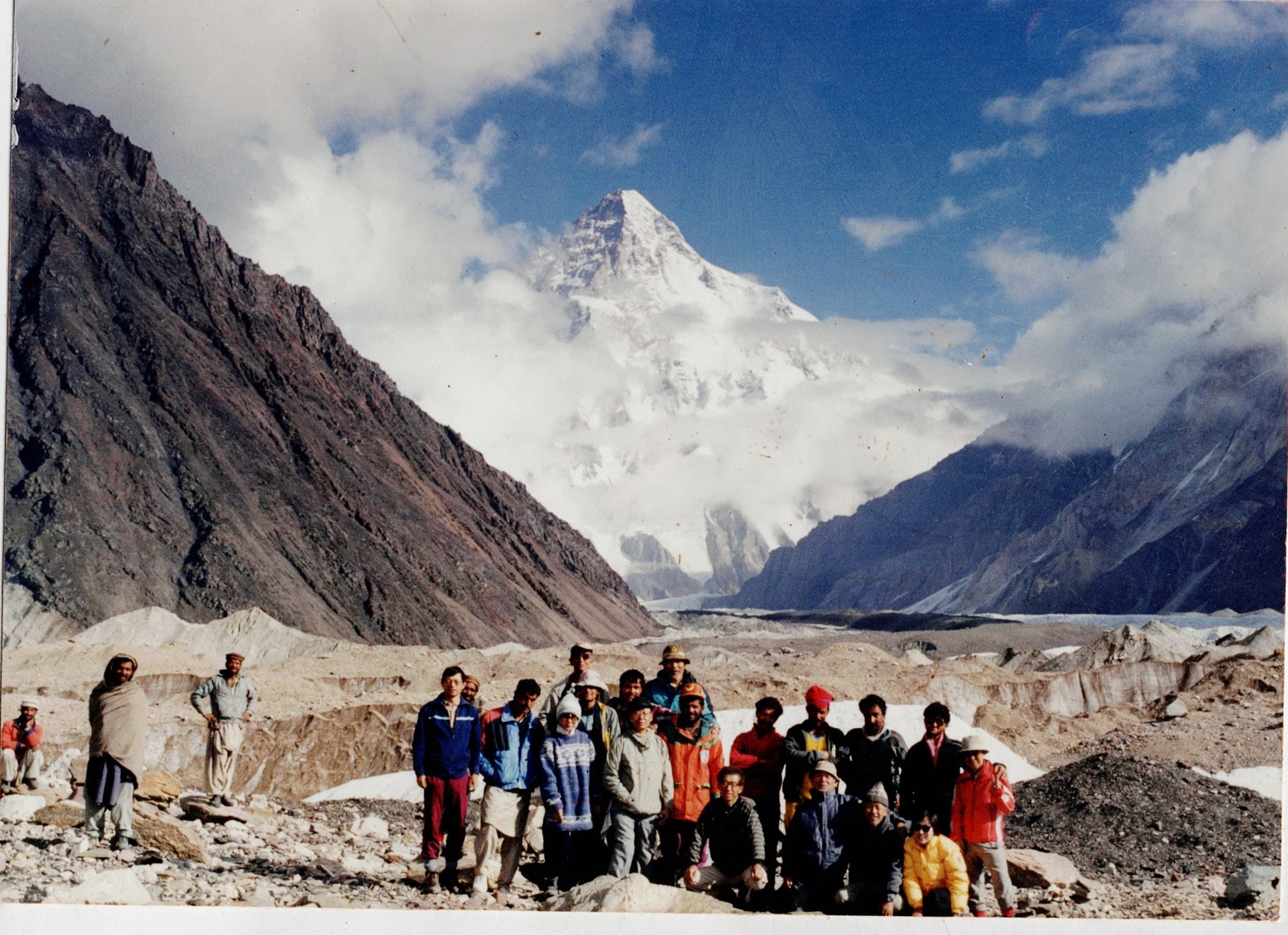
The heart of his working life. Porters, cooks, guides and guests on the moraine of the Baltoro, with the second-highest mountain on earth at the head of the valley.
The whole team, crew and guests together on the glacier near Concordia, with K2 rising at the head of the valley. Porters and crew on the moraine, K2 standing clear above the clouds. 24 June 1995, with the summit pyramid of K2 behind. Four friends on the moraine as cloud builds over the high peaks. A rest stop on the moraine. The porters of these valleys carried every expedition of the era, and they still do. A lone figure on fresh snow below a great pyramid of rock and ice.
The world came to the Karakoram
Look at the faces in these pictures and you are looking at the history of Karakoram climbing. Our father guided visitors from the United States, Germany, Poland, Japan and Austria, and each of those countries had already written its own chapter on these mountains.
Four Austrians made the first ascent of Broad Peak in 1957, without bottled oxygen or high-altitude porters. A Japanese expedition made the second ascent of K2 in 1977, and an American team reached the summit the following year. In 1986 Wanda Rutkiewicz of Poland became the first woman to stand on top of K2, and her compatriots Jerzy Kukuczka and Tadeusz Piotrowski climbed a new route up its south face. German expeditions had been coming to Nanga Parbat since the 1930s.
Most of the people who walked with our father were not chasing summits. They came to see these mountains with their own eyes: to stand at Concordia, where the Godwin-Austen Glacier meets the Baltoro, and look up at K2's 8,611 metres. That walk is still there to do, and our K2 Base Camp trek guide explains how it works today.
Behind every one of those trips stood the people of the valleys: porters, cooks and high-altitude workers from Baltistan and Hunza whose skill made foreign expeditions possible. Their story is told in our guide to the mountaineers of Baltistan.
Chapter three
Life at base camp
Expeditions lived for weeks in camps like these. The mess tent was kitchen, dining room, map room and party venue, and the crew who ran it were as much a part of the trip as the mountain.
A camp pitched on the glacier rubble, granite spires and snow peaks all around. An afternoon at base camp: tents, supply drums and a huge snow face filling the sky. Base camp humour, in front of the blue supply drums every expedition carried up the glacier. Sorting kit in the store tent among blue supply drums, 1995. Evening in the mess tent: tea, a red tablecloth and down jackets zipped to the chin. Guests in Hunza caps around the mess tent table. Crew and guests around one table under a single lantern. A celebration in the mess tent, cake and all.
Chapter four
On snow and ice
Higher up, the work changed: ice axes, heavy packs and long days on snow under a sky so blue it looks black.
Practising on a serac wall with an ice axe, the way skills were passed on: by doing. On a steep snow slope with a full pack. Crossing a high snowfield under a deep blue sky. On a snow ridge high above the valleys, rock towers and glaciers falling away behind. Snow and hanging ice against the dark blue of a high-altitude sky.
Chapter five
Faces of the Karakoram
Friends, guests and crew. Some of these people we can name; many we cannot, yet.
A grin that says the weather held, with a rock spire rising behind. Resting on the moraine, a great snow peak and a frozen glacier basin behind. Two friends on the moraine, same peak, same sunshine. One of the oldest prints in the box: two travellers outside a tent, a huge peak lost in haze behind.
When the visitors stopped coming
Our father's guiding years ended as the century did. After September 2001, foreign travel to northern Pakistan fell away, and for years the trekking seasons that once filled the Baltoro with tents were quiet. Many guides, cooks and porters went back to their fields or found other work.
The mountains did not go anywhere, and neither did the knowledge. It stayed in Aliabad, in stories told at home, and in a box of photographs.
Carrying it forward
Today we, his two sons, carry that work on under a new name: Hunza & Beyond. We run the company from Hunza, the valley he set out from every season. You can read more about us.
Some things have changed completely. We plan around a far bigger range of travellers, from families on a week of forts and lakes to trekkers bound for Concordia, and we keep groups small so we fit into villages instead of overwhelming them. Every scrap of trek waste is carried back down, kitchens cook on gas instead of firewood, and porters work to standard loads with proper kit and insurance. Our sustainability page sets out exactly how we travel.
Some things have not changed at all. The crews still come from the valleys you are walking through. The porters are still the backbone of every expedition. And the mess tent at the end of a long day on the ice is still the best room in the Karakoram.
The glaciers in these photographs are still there. The Karakoram's ice has held up better than most of the world's, a puzzle scientists call the Karakoram anomaly, but the villages below are feeling a warming climate in floods and failing water channels. We explain what is happening on our page about climate change in Gilgit-Baltistan.
Help us name the faces
If you trekked or climbed in the Karakoram between 1980 and 2000, whether from the United States, Germany, Poland, Japan, Austria or anywhere else, you might be in one of these photographs. If you recognise yourself, a friend or a camp, write to us. We would love to add your name and your story, and our father would love to hear from you.
And if you would rather a photo of you was not on this page, tell us and we will take it down.
Questions, answered
Who runs Hunza & Beyond?
Hunza & Beyond is run by two brothers from Aliabad, Hunza, the sons of Muhammad Ghori, who guided trekkers and climbers in the Karakoram from 1980 to 2000. The company carries his work on under a new name.
Can I still trek to Concordia and K2 Base Camp like the groups in these photos?
Yes. The Baltoro route from Askole to Concordia and K2 Base Camp is walked every summer and remains one of the great treks on earth. It lies in a regulated zone, so foreign trekkers need a permit and a licensed guide, arranged through a registered Pakistani operator such as us.
I think I am in one of these photographs. Can I get in touch?
Please do. Write to us through the contact page with the photo and whatever you remember about the trip. We would love to add names and stories, and we will remove any photo of you on request.
Start the conversation
Walk where he walked
The Baltoro, Concordia and K2 Base Camp are still there, and so are the crews. Tell us your dates and we will plan the trek the way it has always worked best: small group, local crew, nothing left behind.