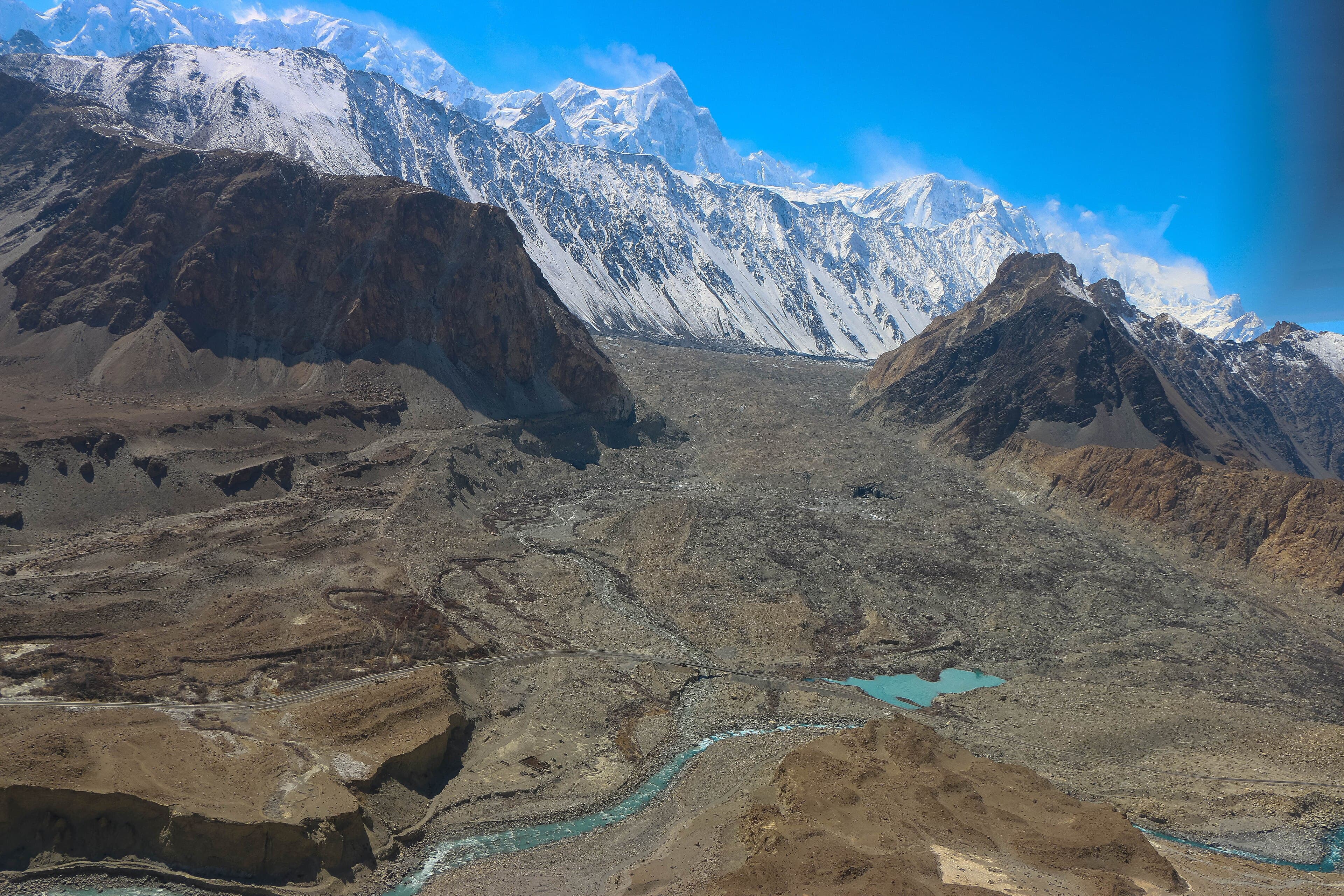
The debris-covered ice of Batura Glacier in upper Hunza, Gilgit-Baltistan

Climate change in Gilgit-Baltistan

The ice is leaving. The floods are not.

Gilgit-Baltistan's glaciers are melting and its glacial lakes are bursting, taking homes, roads, bridges and fields with them. This region did almost nothing to cause it.

We didn't cause this. We are living with it.

Gilgit-Baltistan holds some of the largest concentrations of ice outside the polar regions. Its glaciers feed the Indus, water the apricot orchards and wheat terraces of every village you drive through, and draw climbers and trekkers from all over the world. They are also changing faster than at any time in living memory, and the floods they release are destroying homes, roads, bridges and irrigation channels that took generations to build.

The injustice is stark. Pakistan produces less than 1% of the world's greenhouse gas emissions, and the mountain villages of Gilgit-Baltistan produce a tiny fraction of that. Yet in 2022 Germanwatch ranked Pakistan the country most affected by extreme weather in the world. The people who did the least to heat the planet are among the first to lose their homes to it.

By the numbers

A warning written in ice

glaciers mapped in northern Pakistan's mountains
≈13,000
glacial lakes in Gilgit-Baltistan and Khyber Pakhtunkhwa
3,044
of those lakes assessed as hazardous, likely to cause outburst floods
33
people at risk from glacial floods in GB and KP
7.1 million
Pakistan's share of global greenhouse gas emissions
< 1%
of Himalayan glacier volume could be lost by 2100 on current emissions
Up to 80%

Sources: EvK2CNR/UNDP, UNDP GLOF-II, Government of Pakistan NDC 3.0, ICIMOD. Full list below.

The ice, in numbers

A recent glacier inventory by the EvK2CNR and UNDP Glaciers and Students project mapped 13,032 glaciers across the mountains of northern Pakistan, covering more than 13,500 square kilometres. Most of them are in Gilgit-Baltistan, including the giants you can see or walk beside on a trip here: Batura, Hopper, Passu, and the Baltoro on the K2 Base Camp trek.

As glaciers thin and retreat they leave meltwater behind in lakes dammed by loose rock and ice. UNDP counts 3,044 glacial lakes in Gilgit-Baltistan and Khyber Pakhtunkhwa, and assesses 33 of them as hazardous and likely to produce glacial lake outburst floods. Around 7.1 million people in the two provinces live with that risk.

It is worth being precise, because the Karakoram is complicated. Between roughly 1990 and 2010 some Karakoram glaciers held steady or even grew, a pattern scientists call the Karakoram Anomaly, driven by heavier winter snowfall and thick debris cover. Research since then suggests that pause is ending. The Karakoram is also famous for surging glaciers, like Shisper above Hassanabad, which can lurch forward, block a valley and create a lake that later bursts. Warming makes all of these processes less predictable and more dangerous.

What a glacial lake outburst flood does

A glacial lake outburst flood, or GLOF, happens when the natural dam holding back a glacial lake fails. Millions of cubic metres of water, mud and boulders can pour down a narrow side valley in minutes, often on a hot afternoon with no rain at all. By the time the flood reaches the main valley it is a wall of debris that can bury fields, sweep away bridges and cut the only road in and out.

In mountain valleys there is rarely anywhere else to build. Houses, orchards, schools and roads all sit on the same alluvial fans that floods have used for centuries, and the channels that carry glacier water to the fields are the first thing a flood destroys. When they go, a village can lose its harvest even if every house survives.

Homes, roads and bridges: what is being lost

The damage is not abstract. In recent summers floods have swept away sections of the Karakoram Highway, the lifeline of the entire region, along with bridges on the Baltistan highway, hydropower plants, drinking-water supplies and the irrigation channels that turn desert slopes into orchards. Each loss means weeks or months of isolation, higher prices for food and fuel, and families forced to rebuild with savings they do not have.

The 2022 floods showed how large this can become. Across Pakistan more than 1,700 people died, 33 million were affected and damage and losses passed USD 30 billion, according to the government's post-disaster assessment with the World Bank and UN. In the mountains the losses are smaller in number but devastating in effect, because a single valley may have only one road, one bridge and one water channel.

For travelers, this is also why summer itineraries in Gilgit-Baltistan need slack built in. Roads can close for hours or days after a flood, and our Karakoram Highway guide and advice on whether it is safe to visit Hunza right now explain how we plan around it.

Recent disasters

Four summers in Gilgit-Baltistan

  1. May 2022 · Hassanabad, Hunza

    A flood from the lake formed by the surging Shisper glacier swept away the Hassanabad bridge on the Karakoram Highway and two small power plants.

  2. Summer 2022 · Across Pakistan

    Monsoon floods killed more than 1,700 people, affected 33 million and caused over USD 30 billion in damage and losses.

  3. Summer 2025 · Hassanabad, Hunza

    Repeated Shisper outbursts damaged the Karakoram Highway's protective walls and destroyed crops, irrigation and drinking-water channels. The disaster authority called one flood the highest in the nullah since 2018.

  4. August 2025 · Across Gilgit-Baltistan

    Floods left at least 35 people dead in two days. 318 houses were destroyed and 674 damaged, bridges were lost in Ghanche and on the Baltistan highway, and the Karakoram Highway closed at Gulmit.

  5. August 2025 · Talidas, Ghizer

    A glacial flood buried homes and blocked the Ghizer River, forming a new lake several kilometres long. A shepherds' warning let about 200 people evacuate in time.

  6. July 2026 · Hisper, Nagar

    An outburst flood washed away long sections of the only road into Hisper Valley, while roads in Hushe, Astore and Haramosh were also blocked.

  7. 2026 season · Gilgit-Baltistan

    By late July the disaster authority had recorded 60 flood and GLOF events, 184 houses damaged, 9 bridges lost and nearly 8 km of road washed away.

The future the science describes

ICIMOD, the intergovernmental mountain research centre for the Hindu Kush Himalaya, reported in 2023 that glaciers across the region disappeared 65% faster in 2011 to 2020 than in the previous decade. On current emissions they could lose up to 80% of their volume by the end of this century, and snow cover could fall by up to a quarter.

ICIMOD's earlier assessment found that even if the world holds warming to 1.5°C, the mountains warm more, and about one third of the region's glaciers would still be lost. On a high-emissions path, around two thirds would go. In the short term that means more meltwater and more floods; in the long term it means less water for the nearly two billion people downstream who depend on these rivers.

How communities are fighting back

The people of Gilgit-Baltistan are not waiting to be rescued. Through the UNDP GLOF-II project, funded by the Green Climate Fund and the Gilgit-Baltistan government, valleys at risk now have automatic weather stations, river gauges and early warning sirens, along with gabion walls, spillways and check dams that slow floodwater down.

The Aga Khan Agency for Habitat has mapped hazards for 828 villages across Gilgit-Baltistan and Chitral and trained more than 36,000 community volunteers, over half of them women, together with nearly 200 community emergency response teams. When a glacial flood hit Talidas in Ghizer in August 2025, a warning from shepherds up the valley let around 200 people evacuate before the water arrived, and no one was killed.

Local conservation traditions help too. Village-run conservancies in Hunza and Baltistan manage pastures and wildlife, and Gilgit-Baltistan banned polythene shopping bags from January 2023. None of this can stop the ice melting, but it saves lives and buys time.

What you can do as a visitor

Keep coming. Tourism is one of the few sources of income that reaches the most remote villages, and it helps families recover from floods. Travel with local operators, stay in family-run guesthouses and spend your money in the valleys that are rebuilding. Our sustainability page explains how we try to keep our own footprint small and our spending local.

Travel lightly. Carry a refillable bottle, take your rubbish home from treks, avoid plastic bags and stay longer in fewer places. Respect closures and local advice during the July and August melt season, when floods are most likely.

And tell the story. Share what you saw in these valleys, support established organisations working on disaster preparedness here, and remember them when you vote, travel and choose how to live. The glaciers of Gilgit-Baltistan are melting because of choices made far away. The fix has to come from far away too.

Questions, answered

How many glaciers are there in Gilgit-Baltistan?

A recent inventory mapped about 13,000 glaciers across northern Pakistan's mountains, most of them in Gilgit-Baltistan. Older counts put Pakistan's total at more than 7,000; the difference comes from newer satellite mapping that counts smaller glaciers.

How many glacial lakes in Gilgit-Baltistan are dangerous?

UNDP counts 3,044 glacial lakes in Gilgit-Baltistan and Khyber Pakhtunkhwa and assesses 33 of them as hazardous and likely to cause glacial lake outburst floods. Around 7.1 million people in the two provinces live with that risk.

What is a GLOF?

A glacial lake outburst flood (GLOF) is the sudden release of water when the natural dam of ice or rock holding back a glacial lake fails. The flood carries mud and boulders down narrow valleys in minutes, destroying roads, bridges, homes and irrigation channels.

Is it safe to travel to Gilgit-Baltistan during flood season?

Yes, with planning. Floods are most likely in July and August and mostly affect specific side valleys and road sections for hours or days. Build spare days into your itinerary, follow local advice and closures, and travel with an operator who tracks conditions daily.

How much does Pakistan contribute to climate change?

Very little. Pakistan produces less than 1% of global greenhouse gas emissions, yet Germanwatch ranked it the country most affected by extreme weather in 2022. Mountain regions like Gilgit-Baltistan contribute a tiny share of even that.

Sources

Start the conversation

See these valleys, and help them

Travel with a local team that puts your spending into the communities living on the front line of climate change.