The twelfth summit of the world
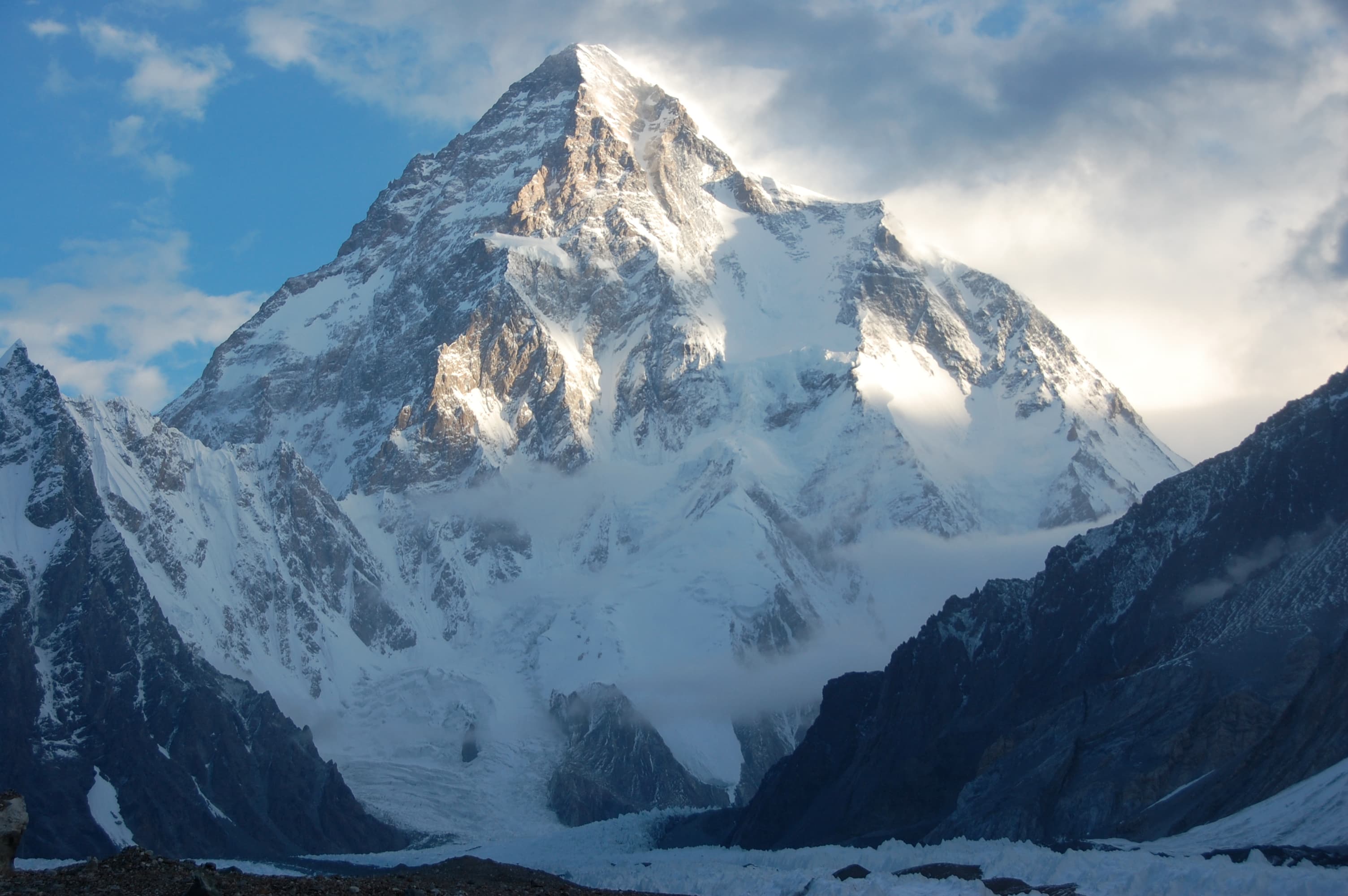
Broad Peak rises to 8,051 metres above the Godwin-Austen Glacier in the Karakoram of Gilgit-Baltistan, the twelfth-highest mountain on Earth and one of five 8,000ers on Pakistani soil. Its neighbour across the glacier, eight kilometres away, is K2 — a proximity that has shaped its entire climbing history, sometimes as understudy, sometimes as training ground, always in the greater mountain's shadow.
The name is literal. The mountain's summit ridge runs for more than a kilometre and a half, a breadth that reminded early surveyors of Breithorn in the Alps; its Balti name, Falchan Kangri, is also in use. The long ridge means Broad Peak actually has three summits over 8,000 metres of relief — the main summit, the central peak and the foresummit that has famously deceived exhausted climbers into stopping short of the true top.
Trekkers know Broad Peak better than they may realise: it is one of the four 8,000-metre peaks visible from Concordia on the K2 Base Camp trek, and the walk up the Godwin-Austen Glacier toward K2 Base Camp passes directly beneath its western flank, where its own base camp sits.
1957: the first ascent that changed the rules
Broad Peak's first ascent is one of mountaineering's landmarks of style. In June 1957 a four-man Austrian team — Hermann Buhl, Kurt Diemberger, Marcus Schmuck and Fritz Wintersteller — climbed the mountain with no high-altitude porters and no supplemental oxygen, all four reaching the summit. At the time, 8,000-metre peaks were being besieged by huge national expeditions; four men doing it alone was a thunderclap.
The 'west-alpine style' of that climb foreshadowed everything the sport later celebrated — the light, fast, self-reliant climbing that Messner and Habeler took to Hidden Peak in 1975 and that defines elite alpinism today. Broad Peak, so often overshadowed by K2, can fairly claim to be where the modern idea began.
The Karakoram exacted its price within weeks: Hermann Buhl, the hero of Nanga Parbat's first ascent, died on nearby Chogolisa when a cornice broke under him. That pairing — landmark achievement and sudden loss, in the same season on the same glacier system — has echoed through the range's history ever since.
Seven decades on the mountain
By the standards of the 8,000ers, Broad Peak was never counted among the killers. Its standard west-spur route is considered one of the more reasonable 8,000-metre climbs, and it has long served as a first eight-thousander for aspiring high-altitude climbers and an acclimatization peak for K2 teams. But 'more reasonable' is a relative term at this altitude, and the mountain's ledger has filled steadily across seventy years.
Its history holds famous episodes of both triumph and grief: the long saga of climbers mistaking the foresummit for the top; the 2013 season in which a serac collapse killed three climbers, and separately a Polish team completed the first winter ascent at the cost of two of its members on the descent. Winter, the foresummit and avalanche-prone snow slopes between the camps have been its recurring dangers.
The 30 July 2026 avalanche, which killed all ten members of Nirmal Purja's expedition between Camp 2 and Camp 3, stands apart in scale — the deadliest single incident in the mountain's history, and among the worst in the Karakoram's. Our companion articles tell the full story of the accident and pay tribute to the climbers.
Why avalanches at 6,600 metres are different
The slope where the 2026 avalanche released — between Camp 2 and Camp 3, around 6,600 metres — is a recognised avalanche zone on the standard route, loaded by the wind and snowfall that the summer's storms had delivered in the preceding weeks. Two climbers had already turned back below the summit in mid-July, reporting poor snow.
At extreme altitude, avalanche risk is managed almost blind. There are no forecasting services for the high Karakoram, no controlled releases, no rescue that can reach a buried climber in the minutes that matter. Teams read weather histories, dig hasty pits, and rely on accumulated judgement — and the 2026 tragedy demonstrated with terrible clarity that judgement, even the best in the world, cannot make an unstable slope safe. The dead included the most accomplished high-altitude climber of his generation and internationally certified guides.
The mountaineering community's discussion since has centred on exactly this: how commercial expeditions weigh summit ambition against conditions, whether the compressed weather windows of a warming Karakoram are concentrating too many climbers into marginal days, and what, if anything, forecasting science can offer the 8,000ers. These questions will shape seasons to come.
The mountain and the communities below it
Every expedition to Broad Peak begins and ends in Baltistan — in Skardu's hotels and outfitters, on the jeep road to Askole, on the shoulders of porters from the Braldu, Shigar and Hushe valleys. The mountain's economy and its grief both flow down to the same villages, a truth written across our guide to the mountaineers of Baltistan.
The 2026 recovery effort showed that relationship at its most profound: Pakistan Army helicopter crews flying repeated sorties, a joint Nepali-Pakistani ground team working the debris field at 5,700 metres, K2 expeditions abandoning their own summit bids to help, and — most movingly — three volunteers from Tissar village in Shigar who climbed on their own initiative to bring Sohail Sakhi, the Hunza climber, down from the mountain thirteen days after the avalanche.
Visitors sometimes ask whether mountaineering is worth what it costs these communities. It is not a question outsiders can settle, but it is worth knowing that Baltistan itself keeps climbing: the sons of porters become guides, the guides become summiteers, and the region's identity is inseparable from the peaks. Respecting that — hiring locally, paying fairly, understanding whose home you are walking through — is the visitor's part of the bargain.
Seeing Broad Peak as a trekker
You do not need to be a climber for Broad Peak to take your breath. The K2 Base Camp trek up the Baltoro Glacier reaches Concordia in ten to twelve days from Skardu, and from that glacial junction Broad Peak's mile-long summit ridge fills the eastern sky beside K2, Gasherbrum IV and the rest of the amphitheatre. The onward walk toward K2 Base Camp passes Broad Peak Base Camp itself.
The trek is strenuous but non-technical — a walk, not a climb, on terrain far removed from the avalanche slopes of the upper mountain — and it runs in the same mid-June to early September season the expeditions use. Everything you need to know is in our dedicated K2 Base Camp trek guide and Skardu trekking overview.
Those who make the walk in coming seasons will find the view changed only in meaning. The mountains do not mark their losses; the people do. Stop at Concordia, find the broad ridge east of K2, and give it a moment — for the ten of 2026, for Buhl's generation, and for everyone the Karakoram has kept.
Questions, answered
How high is Broad Peak and where is it?
Broad Peak is 8,051 metres — the twelfth-highest mountain in the world. It stands in the Karakoram range of Gilgit-Baltistan, Pakistan, directly across the Godwin-Austen Glacier from K2, about eight kilometres away.
Who first climbed Broad Peak?
A four-man Austrian team — Hermann Buhl, Kurt Diemberger, Marcus Schmuck and Fritz Wintersteller — in June 1957, climbing without supplemental oxygen or high-altitude porters. All four reached the summit, a landmark of lightweight style decades ahead of its time.
Is Broad Peak dangerous to climb?
All 8,000-metre peaks are serious, and while Broad Peak's standard route is considered among the more reasonable, its history includes serac collapses, winter tragedies and avalanche-prone slopes between the high camps. The July 2026 avalanche, which killed ten climbers including Nirmal Purja, was the deadliest single incident in the mountain's history.
Can trekkers see Broad Peak?
Yes — it is one of the four 8,000-metre peaks visible from Concordia on the K2 Base Camp trek, and the route toward K2 Base Camp passes directly beneath its western flank. The trek is strenuous but non-technical and runs mid-June to early September.
What does the 2026 avalanche mean for trekking in the region?
Nothing has changed for trekkers: the avalanche occurred at about 6,600 metres on climbing terrain, far above the glacier valleys the treks follow. Skardu, the Baltoro route and Concordia remain open and unaffected, and local guides and operators continue to run the season.