Why Masherbrum was K1
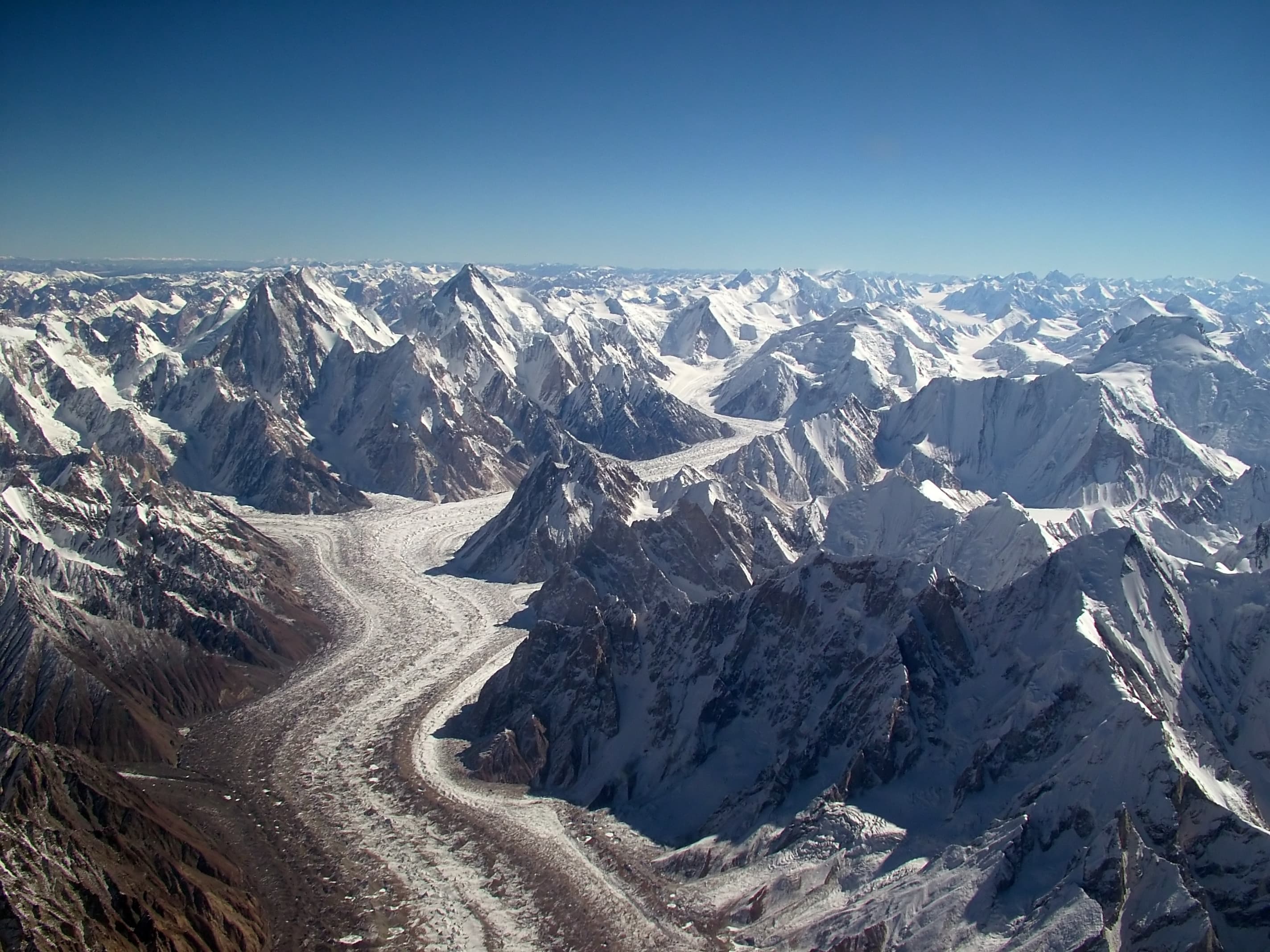
In 1856, when T.G. Montgomerie of the Great Trigonometrical Survey sighted the Karakoram from a peak in Kashmir, the first great summit he marked in his notebook was labelled K1 — and it was Masherbrum, not K2. From the south, Masherbrum dominates the skyline so completely that it was simply the first Karakoram giant a surveyor's eye landed on.
K2 turned out to be taller and kept its survey label forever, while K1 took back its local name. But Masherbrum lost nothing in grandeur: a 7,821-metre pyramid of fluted ice and granite, first climbed in 1960 by an American-Pakistani expedition, with later faces and ridges that still rank among mountaineering's great unsolved problems.
For trekkers, the relevant fact is simpler: you can walk to the foot of this mountain in a couple of days from a village with hot meals and apricot orchards — no glacier marathon required.
Hushe: the village that supplies the Karakoram's climbers
Hushe, at roughly 3,000 metres at the end of the road north of Khaplu, is the highest village in its valley and pound for pound one of the most storied climbing communities on Earth. For generations its men have worked as high-altitude porters and guides on K2, the Gasherbrums and Masherbrum, and several have become internationally respected mountaineers in their own right.
The most famous son is Little Karim, the slightly built porter whose feats of load-carrying at extreme altitude — including hauling a French climber's hang-glider gear high onto K2 — made him a legend of expedition lore and the subject of European documentaries. His story is told properly in our guide to the mountaineers of Baltistan.
Walking through Hushe you feel this heritage everywhere: expedition kit drying on rooftops, climbing certificates on guesthouse walls, and children who can name the 8,000ers the way others name football teams.
The Masherbrum Base Camp trek
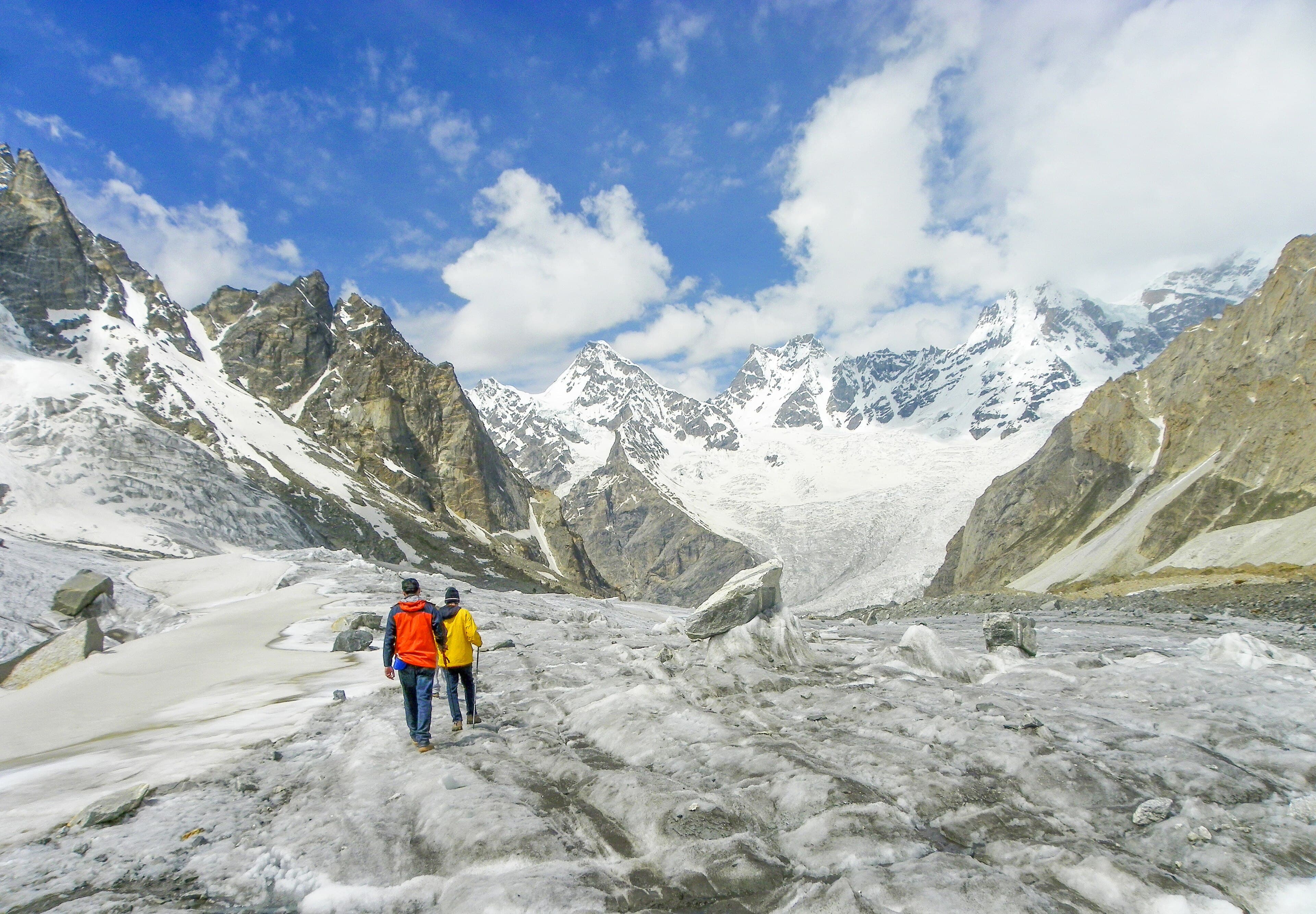
The signature short trek climbs north from Hushe through willow groves and the summer pastures of Parbisan toward Masherbrum Base Camp, set on meadows beneath the mountain's south face. Most parties take two to three days for the round trip, sleeping at shepherd settlements or camps along the way.
The walking is moderate — steady valley gradients rather than moraine chaos — which makes this one of the very few places where ordinary hikers can stand beneath a 7,800-metre wall without expedition logistics. The face above the meadows rises nearly four vertical kilometres.
June to September is the season, with wildflowers at their best in July. Combined with travel days via Khaplu, the whole experience fits inside a week from Skardu.
The Charakusa Valley: an amphitheatre of granite
East of Hushe, the Charakusa Valley is spoken of with reverence by the world's best alpinists. Its walls and towers — K7, K6, Link Sar and a crowd of nameless spires — have hosted many of the most admired hard climbs of the modern era, and every season small professional teams quietly base themselves here.
Trekkers get the same amphitheatre for a walker's effort: a two-to-four-day valley trek over meadows and old moraine to base camps ringed by granite. If the Trango Towers are the Karakoram's cathedral front, the Charakusa is its cloister — equally magnificent, almost empty.
Because expeditions here are small and the valley sees few visitors, wildlife sightings — ibex on the slopes, golden eagles overhead — are noticeably more common than on the Baltoro corridor.
The Gondogoro side and Laila Peak
A third valley runs northwest from Hushe toward the Gondogoro Glacier — the back door to the Baltoro. Trekkers crossing the Gondogoro La from Concordia descend this way, and the camps at Saicho and Khuspang can also be visited from Hushe as a destination in their own right.
The scene-stealer here is Laila Peak, a 6,000-metre blade of snow whose impossibly sharp profile has become one of the most photographed mountain shapes in Pakistan. From the Gondogoro valley meadows it looks less like a mountain than a spear thrust through the ridgeline.
Walking up-valley from Hushe for even a day or two earns you Laila views and a taste of the high Karakoram — a genuine option for travellers who want the postcard without a 5,600-metre pass.
Homestays and community tourism
Hushe and the villages below it — Kande, Machulo, Khane — have invested in community-based tourism: family homestays, locally owned guesthouses, and women's enterprises producing handicrafts and dried fruit. Staying in them keeps your money in the valley and turns a trek into a relationship.
Evenings here are the antidote to expedition impersonality: butter tea and balay noodle soup by the stove, stories from porters who have wintered on K2's flanks, apricot harvests on shared rooftops. Khaplu, an hour or two down-valley, adds the restored Khaplu Palace and the medieval Chaqchan Mosque to your route.
Hiring locally matters too. Guides and porters from the Hushe Valley are among the most experienced in the Karakoram, and trekking with them — at fair, transparent wages — directly supports the community whose mountains you've come to see.
Hushe or the Baltoro? An honest comparison
Choose the Baltoro and K2 Base Camp if you want the icons: K2 from Concordia, the full glacier pilgrimage, two committed weeks. It is unmatched — and in July it is also busy, expensive and logistically heavy, as our K2 & Concordia trek pages make clear.
Choose Hushe if you want the same mountain range with solitude, villages, shorter itineraries and a fraction of the cost. You will not see K2, but you will stand beneath Masherbrum and Laila Peak, sleep in homes rather than only tents, and quite possibly have a 7,000-metre amphitheatre entirely to yourself.
The connoisseur's answer is both: trek the Baltoro, cross the Gondogoro La, and finish in Hushe — the hardest and most complete journey the Karakoram offers a trekker. However you come, getting here is simple: a half-day jeep ride from Skardu via Khaplu, best from June to early October.
Questions, answered
Where is the Hushe Valley and how do you get there?
The Hushe Valley lies in eastern Baltistan, north of Khaplu — roughly a half-day drive from Skardu by jeep. Hushe village, at about 3,000 metres, is the roadhead and base for treks to Masherbrum Base Camp, the Charakusa Valley and the Gondogoro Glacier.
How hard is the Masherbrum Base Camp trek?
It's a moderate two-to-three-day round trip from Hushe village through pastures to meadows beneath Masherbrum's south face — no glacier travel or technical ground on the standard route. Reasonable hill fitness and a night or two of acclimatization in Skardu or Khaplu are enough.
Why was Masherbrum called K1?
During the 1856 Kashmir survey, T.G. Montgomerie numbered the Karakoram peaks in the order he sighted them, and Masherbrum — most prominent from his southern viewpoint — became K1, before K2. Masherbrum later reverted to its local name, while K2, with no settled local name in use, kept its survey label.
Is the Hushe Valley a good alternative to the K2 Base Camp trek?
Yes, if you want big-mountain scenery with far fewer people, shorter itineraries and village life. You won't see K2 itself, but you'll trek beneath Masherbrum and Laila Peak, stay in homestays, and spend a fraction of the Baltoro's cost and time.
When is the best time to trek in the Hushe Valley?
June to September is ideal, with July bringing the best wildflowers in the high pastures; early October can still work for lower walks. Winters are harsh and the valley effectively closes to trekking.