1856: two letters and a number
Karakoram climbing history begins not with a climber but with a surveyor. In 1856, T.G. Montgomerie of the Great Trigonometrical Survey of India, working from a peak in Kashmir, sketched the distant Karakoram and assigned its giants provisional labels: K1 for the most prominent — the mountain locals call Masherbrum — and K2 for the colossus behind it.
Most survey labels were later replaced by local names. K2 kept its code because no single settled local name was in common use for a peak hidden from every inhabited valley — and so the world's second-highest mountain, at 8,611 metres, carries to this day the most austere name in geography.
The measurement itself stunned the survey: K2 stood within 240-odd metres of Everest, in a range nobody in Europe had mapped. The Karakoram's modern story starts with that arithmetic.
1909: the Duke of the Abruzzi and the photographs that launched a century
Serious mountaineering arrived in 1909 with Prince Luigi Amedeo, Duke of the Abruzzi, who led a lavish Italian expedition up the Baltoro to attempt K2. His team reached roughly 6,000 metres on the southeast ridge before retreating — but that ridge, the Abruzzi Spur, became the line by which K2 would eventually be climbed and remains its standard route today.
The expedition's most enduring summits were photographic. Vittorio Sella's large-format images of K2, the Baltoro and the Trango spires are still regarded as some of the finest mountain photographs ever made, and they did more than any text to fix the Karakoram in the world's imagination.
Abruzzi also pushed to nearly 7,500 metres on Chogolisa — a world altitude record at the time — and left his name on the glacier under the Gasherbrums that trekkers follow to this day.
1954: triumph and a forty-year shadow on K2
On 31 July 1954, Achille Compagnoni and Lino Lacedelli of Ardito Desio's Italian expedition stood on K2's summit — the first ascent of the world's second-highest mountain, achieved a year after Everest fell. Italy erupted; in Pakistan, too, the climb became part of the mountain's legend.
But the triumph carried a shadow. The summit pair had moved their top camp from its agreed position, and Walter Bonatti — climbing in support with the Hunza porter Amir Mehdi, carrying the oxygen the summit depended on — could not find the tent in darkness. The two survived a brutal open bivouac near 8,100 metres; Mehdi lost his toes to frostbite, and the expedition's official account then minimised the episode and cast unjust aspersions on Bonatti for decades.
Bonatti spent half a century fighting for the truth, and the historical record was finally corrected in the 2000s, when the Italian Alpine Club's review acknowledged his and Mehdi's account. The controversy matters because it asks the Karakoram's permanent question: who carries, who summits, and who gets remembered.
1957–1958: the golden age comes to the Baltoro
In June 1957 a four-man Austrian team — Hermann Buhl, Kurt Diemberger, Marcus Schmuck and Fritz Wintersteller — climbed 8,051-metre Broad Peak in self-organised 'west-alpine style': no high-altitude porters and no supplemental oxygen, with all four reaching the summit. It was a thunderclap of a demonstration that small teams could climb 8,000ers — though the Karakoram took its fee weeks later, when Buhl died through a cornice on Chogolisa.
The following year, 1958, Americans Pete Schoening and Andy Kauffman made the first ascent of Gasherbrum I, Hidden Peak — at 8,080 metres, the highest first ascent ever achieved by American climbers and the only 8,000er first climbed by them.
That same season, Italians Walter Bonatti and Carlo Mauri summited Gasherbrum IV — at roughly 7,925 metres not an 8,000er, but by common consent one of the hardest summits then reached by anyone, a redemption climb for Bonatti four years after K2.
1985: the Shining Wall, the 'climb of the century'
Gasherbrum IV returned to the centre of the sport in 1985, when Poland's Voytek Kurtyka and Austria's Robert Schauer climbed its West Face — the vast Shining Wall that glows above Concordia — in pure alpine style. Trapped near the summit ridge by storm, starving and hallucinating, they descended by a different route without reaching the very top, and called it the most extreme experience of their lives.
Climbing history's verdict inverted the usual rules: despite stopping short of the summit, the ascent of the face was hailed as the 'climb of the century', and it remains unrepeated in full. It stands for an idea the Karakoram taught the world — that how you climb can matter more than whether you tag the top.
Trekkers at Concordia see the Shining Wall at sunset exactly as Kurtyka and Schauer first studied it. No anecdote on the Baltoro lands harder than that one, told within sight of the face.
Granite years: the Trango Towers and the big-wall era
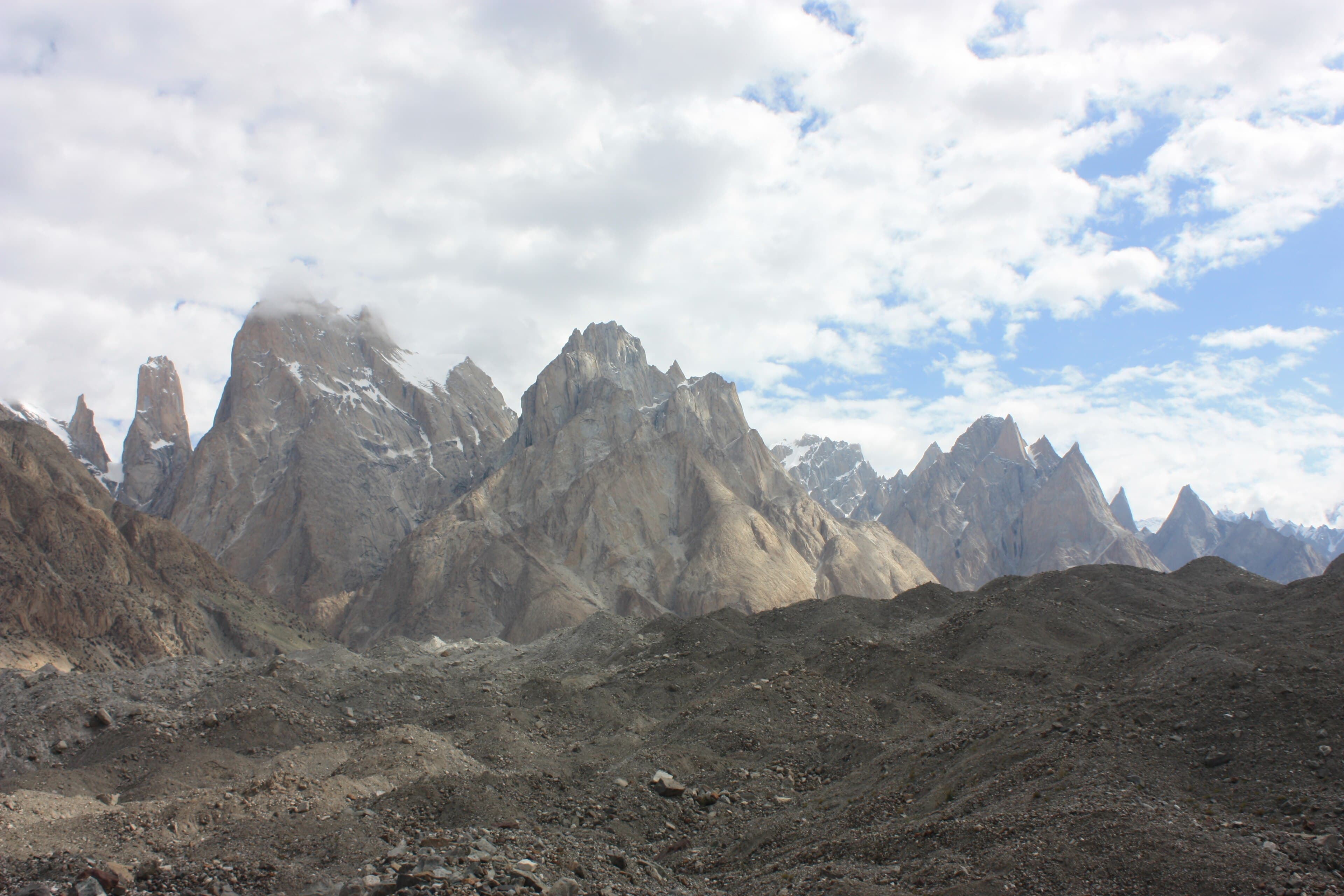
From the mid-1970s the Karakoram opened a second front: its granite. The Trango Towers above the lower Baltoro — including the freestanding Nameless Tower and Great Trango — became the world's most coveted big walls after a British team including Joe Brown and Mo Anthoine made the Nameless Tower's first ascent in 1976.
What followed was a golden age of vertical climbing: enormous aid and free routes on Great Trango's walls among the biggest cliff faces on Earth, landmark free ascents on the Nameless Tower, and BASE-jump and portaledge sagas that filled climbing films for decades. Uli Biaho, the Latok group and the Ogre — where Doug Scott famously crawled down with two broken legs in 1977 — round out the neighbourhood's legends.
For trekkers the payoff is visual: the second and third days on the Baltoro pass directly beneath this skyline, and with binoculars from Paiju or Urdukas you can pick out the very lines that made the era.
Messner, the 8,000er race and the Karakoram's central role
Reinhold Messner's 1975 alpine-style ascent of Gasherbrum I with Peter Habeler — two men, no oxygen, no fixed camps — was staged in the Karakoram, and it redefined what climbing an 8,000er meant. When Messner in 1986 became the first person to climb all fourteen 8,000-metre peaks, the race he completed had run substantially through Baltistan: four of the fourteen stand at the head of the Baltoro.
The Karakoram was also where the hardest versions of the game were played: K2's Magic Line and south face attempts, the tragic summer of 1986 when thirteen climbers died on K2, and the Polish winter campaigns that closed the century. Climbers came to speak of the range as the connoisseur's Himalaya — steeper, wilder and less forgiving than Nepal.
Pakistani climbers entered the record book in force in this era too, from Nazir Sabir's K2 ascent in 1981 to the Sadpara generation chronicled in our mountaineers of Baltistan guide.
16 January 2021: ten climbers, one rope length, history
By 2020, K2 was the last 8,000-metre peak never climbed in winter — the 'savage mountain' in its most savage season, with jet-stream winds and temperatures below minus 50. That winter an unprecedented gathering of expeditions assembled at base camp to try.
On 16 January 2021, ten Nepali climbers — among them Nirmal Purja and Mingma Gyalje Sherpa — joined forces from separate teams, waited a few metres below the top so no one would summit ahead of the others, and walked onto K2's summit together singing Nepal's anthem. It was instantly recognised as one of the great moments in mountaineering history, and a long-overdue headline triumph for the Sherpa and Nepali climbers on whose work Himalayan climbing had always rested.
The same winter took Muhammad Ali Sadpara, John Snorri and Juan Pablo Mohr on their own summit attempt weeks later — triumph and tragedy in a single season, in the fullest Karakoram tradition.
Touching the history: what a trekker can actually visit
This entire story is walkable. The standard K2 Base Camp trek up the Baltoro passes beneath the Trango Towers, camps at Abruzzi-era sites like Urdukas, and arrives at Concordia with the Shining Wall and K2 arranged exactly as Sella photographed them in 1909.
At K2 Base Camp you can pay respects at the Gilkey Memorial — begun for Art Gilkey of the 1953 American expedition and now bearing plates for Ali Sadpara and the many others the mountain kept. Strong parties continue to Broad Peak and Gasherbrum base camps, or exit over the Gondogoro La toward the Hushe Valley, home of the porter legends.
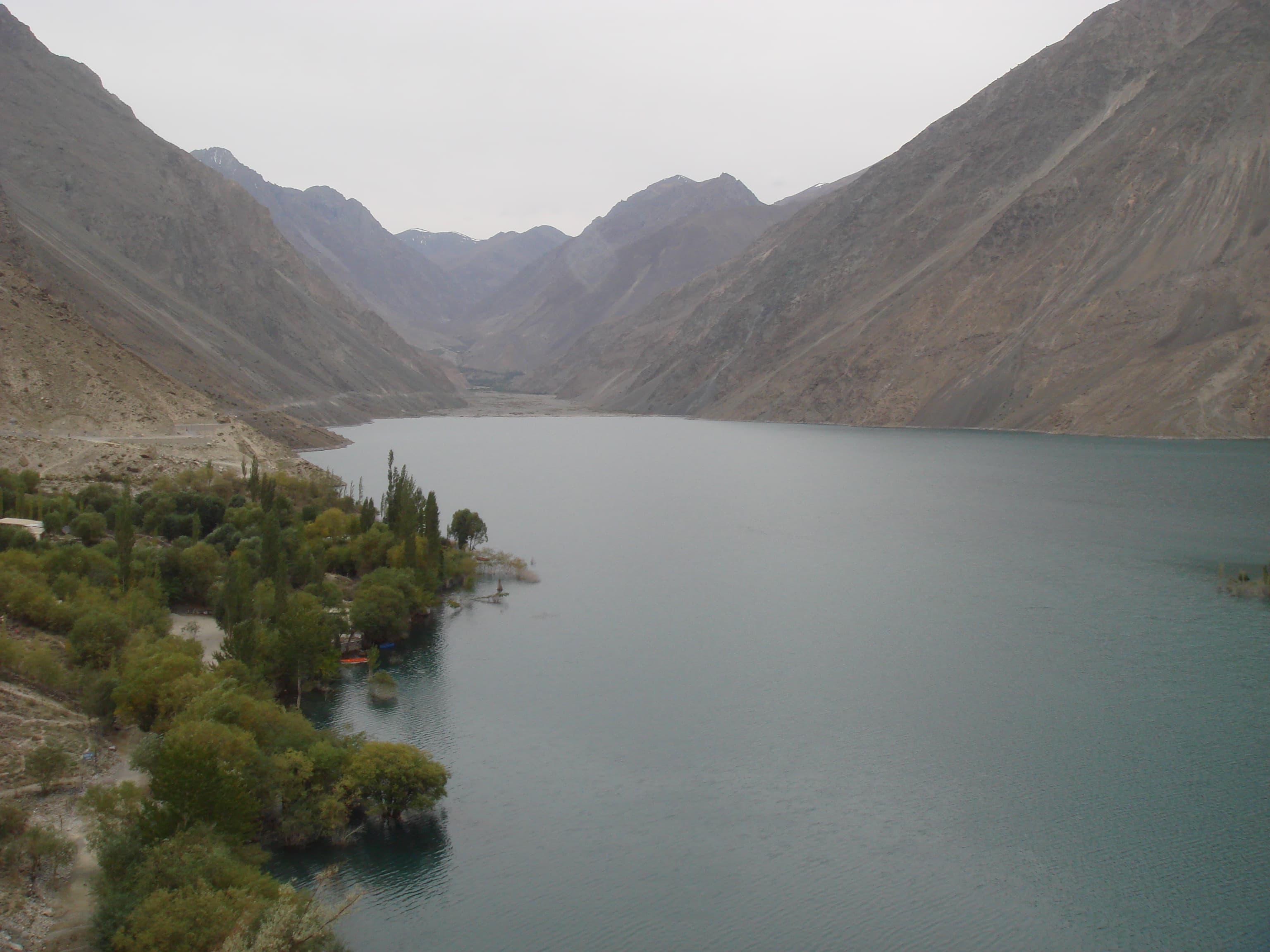
Around Skardu, history is quieter but everywhere: expedition photographs in hotel lobbies, Sadpara village above Satpara Lake, and old porters in the bazaar who carried for names you know. Start with our Skardu trekking guide — the door to all of it.
Questions, answered
Who climbed K2 first?
Achille Compagnoni and Lino Lacedelli of an Italian expedition led by Ardito Desio summited K2 on 31 July 1954. The ascent depended on oxygen carried high by Walter Bonatti and the Hunza porter Amir Mehdi, whose forced open bivouac near 8,100 metres became one of climbing's longest-running controversies.
Why is K2 called K2?
It's a survey label: in 1856 T.G. Montgomerie of the Great Trigonometrical Survey numbered the Karakoram peaks from his viewpoint in Kashmir, marking Masherbrum K1 and this peak K2. Because no single local name was in settled use for the hidden giant, the code stuck.
What was the Bonatti K2 controversy?
After the 1954 first ascent, the expedition's account obscured the fact that Walter Bonatti and porter Amir Mehdi had carried the summit oxygen and survived a desperate open bivouac near 8,100 metres after the top camp was moved. Bonatti was unfairly maligned for decades until the record was officially corrected in the 2000s.
Who climbed K2 in winter?
On 16 January 2021, ten Nepali climbers — including Nirmal Purja and Mingma Gyalje Sherpa — made the first winter ascent of K2, deliberately stepping onto the summit together. It was the last 8,000-metre peak to be climbed in winter.
Can trekkers visit the Gilkey Memorial and Concordia?
Yes — both lie on the standard K2 Base Camp trek up the Baltoro Glacier from Askole, a strenuous camping trek of roughly two weeks best done July to August. Concordia delivers the classic K2 panorama, and the Gilkey Memorial stands on a ridge above base camp.