A kingdom the size of a valley
For most of recorded history, Hunza was an independent principality — a state the size of a single river valley, ruled by a hereditary prince called the Mir (or Tham, in the old Burushaski title). Its borders ran from the gorge below Nagar to the high passes of the Karakoram, and within them the Mir's word was law: he taxed the caravans, commanded the levies and settled disputes from a throne room the size of a living room.
What the kingdom lacked in size it made up in position. Hunza sat astride a branch of the Silk Road between Chinese Turkestan and Kashmir, with terraced fields engineered into cliff faces and watchtowers above every bridge. Travellers from Marco Polo's era onward described the people of these gorges as tough, shrewd and impossible to conquer cheaply — an assessment the British would eventually test.
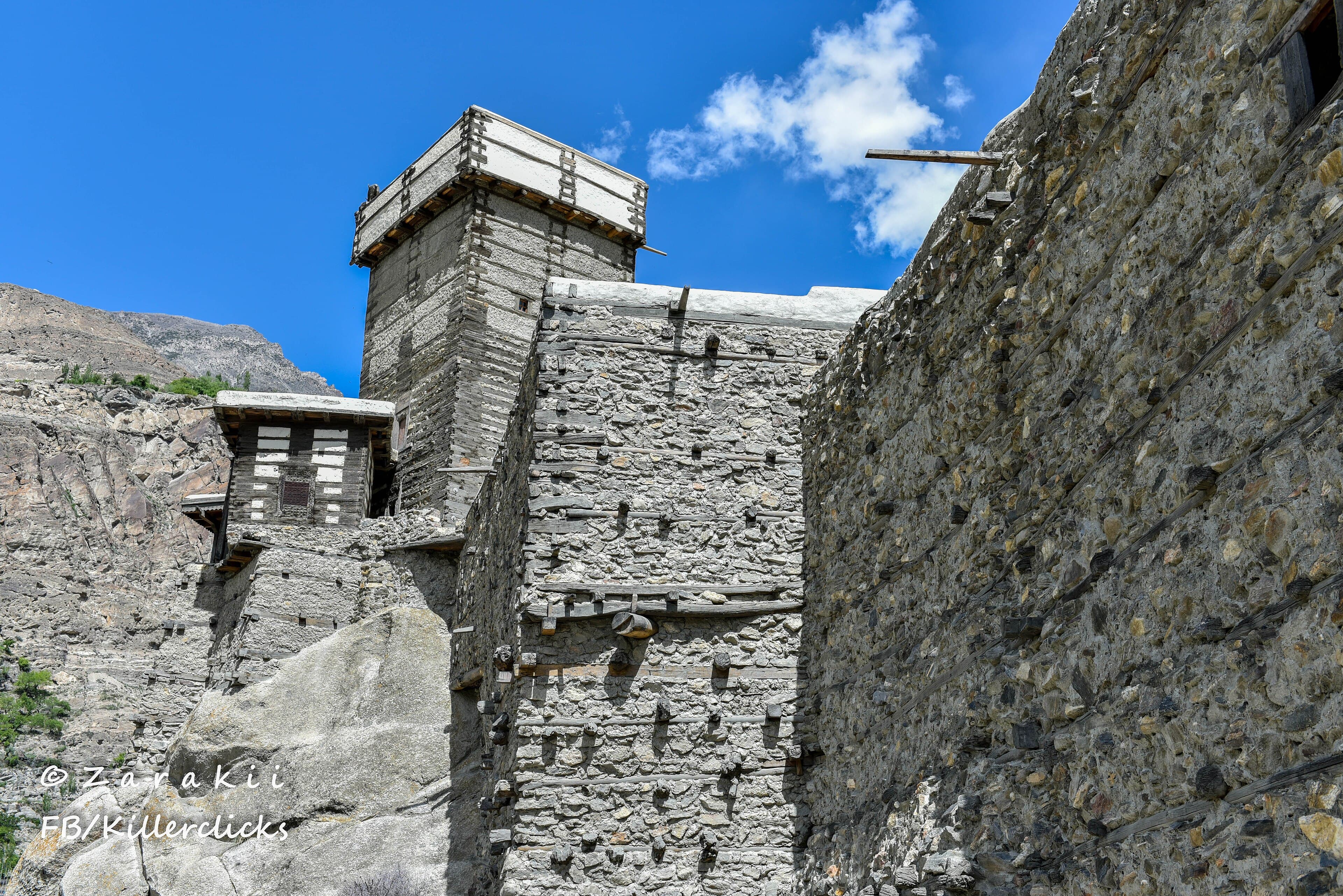
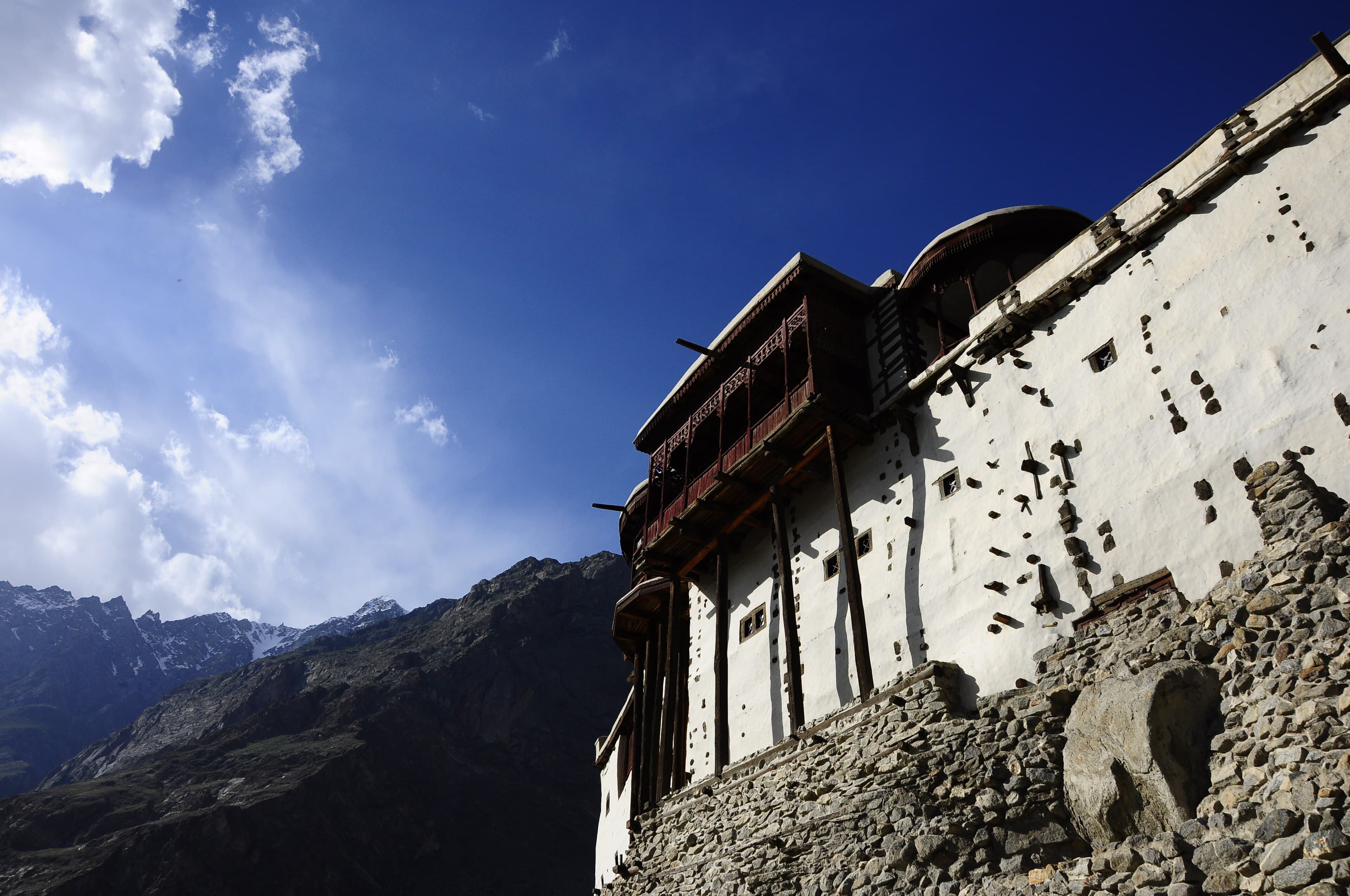
The royal seat moved once in the kingdom's long life. Altit Fort, perched on a sheer rock above the river, is the older residence — its Shikari watchtower has stood for roughly 1,100 years, making it the oldest surviving building in Gilgit-Baltistan. Around three centuries later the ruling line shifted uphill to Baltit Fort, whose commanding moraine perch above today's Karimabad served the Mirs for some 700 years.
Altit, Baltit and a tale of two brothers
Local tradition explains the two forts with a family quarrel. The princely line split between two brothers — one holding Altit, the other Baltit — and their rivalry ended with the Baltit branch supreme. Whatever the precise truth, the geography is eloquent: Altit guards the river and the old road, while Baltit watches everything from above, and together they bracketed the heart of the kingdom.
Baltit Fort's architecture tells its own story of Himalayan connections. When a Mir married a princess from Baltistan — itself deeply tied to Ladakh and Tibet — craftsmen from Baltistan are said to have come as part of her dowry and rebuilt the fort, which is why Baltit's timber-laced walls and jutting balconies remind so many visitors of Leh Palace and, distantly, of Lhasa.
The forts were never luxurious. They were administrative machines: grain stores, dungeons, guest rooms for envoys, rooftop audience spaces where the Mir sat in judgment with the whole kingdom — fields, bridges, passes — spread out below him like a map. That view from Baltit's roof remains the single best history lesson in the valley.
Rivals, raiders and the long game with China
Hunza's oldest enemy was its closest neighbour. Nagar, the principality across the river, mirrored Hunza fort for fort and raid for raid, and the two states feuded for centuries across a gorge narrow enough to shout insults over. The rivalry was real — bridges were cut and villages burned — but it was also a kind of equilibrium, with marriages between the ruling houses punctuating the wars.
Beyond the valley, the Mirs played a careful double game. Hunza sent regular missions over the Mintaka Pass to Chinese authorities in Kashgar — gifts of gold dust that the Chinese court politely recorded as tribute, in exchange for gifts of greater value and a powerful, distant patron. At the same time, Hunza acknowledged loose ties to Kashmir to the south, taking subsidies from both directions while obeying neither.
The kingdom's third income stream was less diplomatic: raiding the caravan road between Leh and Yarkand and trading captives into Central Asia. By the 1880s this combination — caravan raiding, a Chinese connection, and a flirtation with Russian agents — had drawn the alarmed attention of British India, for whom the high passes were no longer remote curiosities but possible invasion routes.
The Great Game arrives: the campaign of 1891
In the late nineteenth century, the British and Russian empires shadow-boxed across Asia in what became known as the Great Game, and tiny Hunza found itself on the board. When Mir Safdar Ali received Russian visitors and continued raiding while rebuffing British terms, the Government of India resolved to settle the question of the passes by force.
The Hunza-Nagar Campaign of December 1891 was short and sharp. A British-led force of around a thousand Gurkha, Kashmiri and Punjabi troops with local levies fought its way up the gorge, and the decisive action came at Nilt, where stone fortresses above the river had to be stormed under fire — a fight that produced three Victoria Crosses. Within three weeks the campaign was over.
Mir Safdar Ali fled over the passes to Kashgar, where he died in exile, and the British installed his half-brother, Mir Muhammad Nazim Khan, on the throne. The terms were typical of British India's frontier: Hunza kept its Mir, its laws and its daily life, but the raids ended, the passes came under British watch, and a Political Agent in Gilgit kept a polite, unblinking eye on the kingdom.
The British decades: a quiet kingdom
The half-century after 1891 was, by Hunza's standards, remarkably calm. Mir Muhammad Nazim Khan reigned for nearly five decades as a loyal and canny ally of the British, and the kingdom that had lived on raiding turned its energy back to its true genius: agriculture. The terraces, orchards and water channels that make Hunza so beautiful today were extended and perfected in these years.
Visitors of the era — officers, surveyors and the occasional adventurous traveller — sent home glowing accounts of the valley: its longevity legends, its apricots, its astonishing irrigation engineering and the courtesy of its people. The Lorimers, a British political agent and his linguist wife who lived in the valley in the 1930s, documented its language and daily life in books and photographs that remain priceless records.
It was in this period that Hunza's modern identity began to form. The Mirs and most of the population belonged to the Ismaili branch of Shia Islam, whose spiritual leader, the Aga Khan, encouraged education and self-help — seeds of the schools and development networks that would later make Hunza one of the most literate places in Pakistan.
1947 and 1974: joining Pakistan, ending the throne
British India's partition in 1947 left the Gilgit region in limbo, nominally part of the Maharaja of Kashmir's state. In November 1947 the locally recruited Gilgit Scouts rebelled against the Maharaja's governor and declared for Pakistan, and the Mir of Hunza, Muhammad Jamal Khan, formally acceded his state to the new country — by telegram, in one of partition's more remote dramas.
Hunza then lived a curious double life for a generation: part of Pakistan, yet still an internally self-governing princely state where the Mir held court as his ancestors had. That arrangement ended in 1974, when Prime Minister Zulfikar Ali Bhutto dissolved the remaining princely states; Hunza's roughly nine centuries of recorded royal rule closed not with a battle but with an administrative order.
The royal family remains a respected presence in the valley — descendants of the Mirs have served in public life and heritage causes — and the dissolution coincided almost exactly with the Karakoram Highway's arrival, which transformed the old kingdom from a closed mountain world into one of Asia's great travel destinations within a single generation.
Saving the forts: the Aga Khan restorations
By the 1980s, Baltit Fort was dying. The royal family had moved to a modern residence decades earlier, and the empty fort — mud, stone and ancient timber — was sliding toward collapse. The Aga Khan Trust for Culture stepped in with a meticulous conservation project through the early 1990s, restoring the fort with traditional materials and techniques and reopening it in 1996 as a museum run for the community's benefit.
The restoration became a model studied worldwide — proof that heritage conservation could anchor an entire local economy — and it earned international heritage honours. The same approach then turned to Altit Fort and its old village, whose restoration won a UNESCO Asia-Pacific heritage award; the project trained local craftspeople, including women carpenters, in skills the valley had nearly lost.
The forts' rebirth rippled outward: the old settlements at their feet were rehabilitated rather than demolished, and Karimabad's heritage core survives today because the forts made the past profitable. It is hard to name another place in South Asia where conservation so visibly pays the bills of ordinary families.
Visiting Baltit and Altit today
Baltit Fort is reached by a cobbled lane climbing through Karimabad's bazaar — go on foot, slowly, because the approach through the old village is half the experience. Inside, guided tours lead through grain stores, the dungeon, royal apartments and the museum's displays of weapons, utensils and photographs, ending on the rooftop with its sweeping view from Rakaposhi to Ultar.
Altit Fort, fifteen minutes away, feels different: older, starker, and dramatically perched with a sheer drop to the Hunza River behind its watchtower. Below it, the restored Royal Garden — a centuries-old orchard of apricots and mulberries — now hosts a café run by local women and one of the loveliest picnic lawns in the valley.
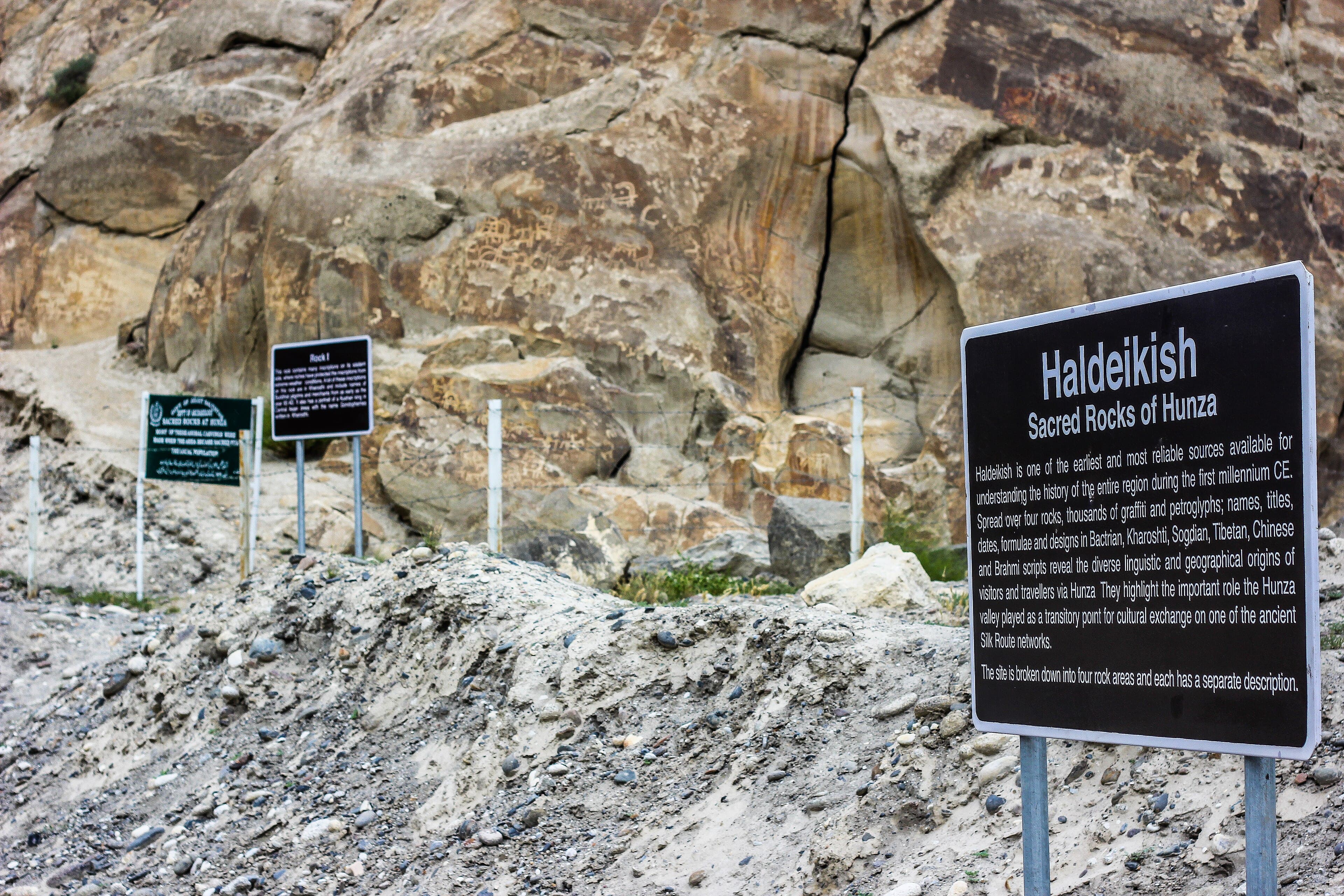
Give the pair a full half-day, and thread in Ganish village and the Sacred Rocks for the complete arc from Silk Road to kingdom to museum. Both forts are open daily through the tourist season for a modest entry fee that funds their upkeep; mornings have the best light and the thinnest crowds.
Questions, answered
How old is Baltit Fort?
Baltit Fort served the Mirs of Hunza for roughly 700 years, with the structure remodelled many times — most famously after a royal marriage brought Balti craftsmen whose work gives it a Tibetan-style silhouette. It was restored by the Aga Khan Trust for Culture and reopened as a museum in 1996.
Who were the Mirs of Hunza?
The Mirs were the hereditary princes who ruled the Hunza Valley as an independent, later semi-autonomous, state for centuries. They governed first from Altit Fort and then Baltit Fort, survived the British campaign of 1891 as allied rulers, acceded to Pakistan in 1947, and reigned until the princely state was dissolved in 1974.
What happened in the Hunza-Nagar Campaign of 1891?
A British-led force fought a three-week campaign up the Hunza and Nagar gorges in December 1891, with the hardest fighting at Nilt, where three Victoria Crosses were earned. Mir Safdar Ali fled to Kashgar and the British installed Mir Muhammad Nazim Khan, ending Hunza's caravan raids and full independence.
When did Hunza become part of Pakistan?
In November 1947, after the Gilgit Scouts' rebellion against the Maharaja of Kashmir's rule, the Mir of Hunza acceded his state to Pakistan. Hunza remained an internally self-governing princely state until 1974, when Prime Minister Bhutto dissolved it and the valley was absorbed into Pakistan's Northern Areas, today's Gilgit-Baltistan.
Can you visit Baltit and Altit forts, and which is better?
Both are open daily in season with guided tours and modest entry fees. Baltit offers the grander museum and rooftop panorama over Karimabad; Altit is older — its watchtower is about 1,100 years old — with a dramatic river-edge setting and the lovely Royal Garden café. Seeing both takes an easy half-day.