Why Hunza's blossom season is special
Every spring, the orchard valleys of Gilgit-Baltistan stage one of Asia's great blossom spectacles. Cherry, apricot, almond, peach and apple trees — hundreds of thousands of them, planted in terraces over centuries — bloom in waves of white and pink beneath mountains still deep in winter snow. The contrast is the magic: soft petals in the foreground, 7,000-metre ice walls behind.
Unlike Japan's sakura season, you won't share the view with crowds. Blossom season falls in Gilgit-Baltistan's shoulder season, hotels have space, the light is crystalline after winter, and village life — ploughing, pruning, the first irrigation water of the year — carries on around you. Many travellers rate it above the famous October colours, and it's certainly the more intimate experience.
A botanical note for the pedantic: much of what's marketed as 'cherry blossom' in Hunza is actually apricot blossom — Hunza is one of the world's great apricot-growing valleys — blooming alongside true cherries and almonds. The mix is part of the charm: whites, pale pinks and deep pinks layered through the same terraces.
When exactly does it bloom? Altitude is the clock
Bloom timing follows altitude with surprising precision: lower, warmer valleys flower first, and the wave climbs roughly week by week. Broadly, the season runs from late March to mid-April. Skardu and the Baltistan valleys (around 2,200–2,400 m) typically begin in the last week of March; central Hunza around Karimabad and Altit (about 2,400–2,500 m) usually peaks in the first half of April; higher villages such as Duikar and parts of Nagar bloom last, sometimes holding petals toward mid-to-late April.
Exact dates shift up to a week either way with the warmth of the late winter, so build flexibility in rather than betting everything on fixed dates. The most reliable strategy is a 7–10 day trip in the first half of April that moves upward with the bloom — start in Skardu or lower Hunza, finish high. Individual trees hold flowers for a week or so; a whole village's display lasts two to three.
If your dates are forced earlier, favour Baltistan; if later, favour upper Hunza and Nagar. And remember the consolation prize is genuine: even past peak bloom, falling petals over the terraces and the first green of poplar leaves make late April quietly beautiful.
The best blossom spots in Hunza and Nagar
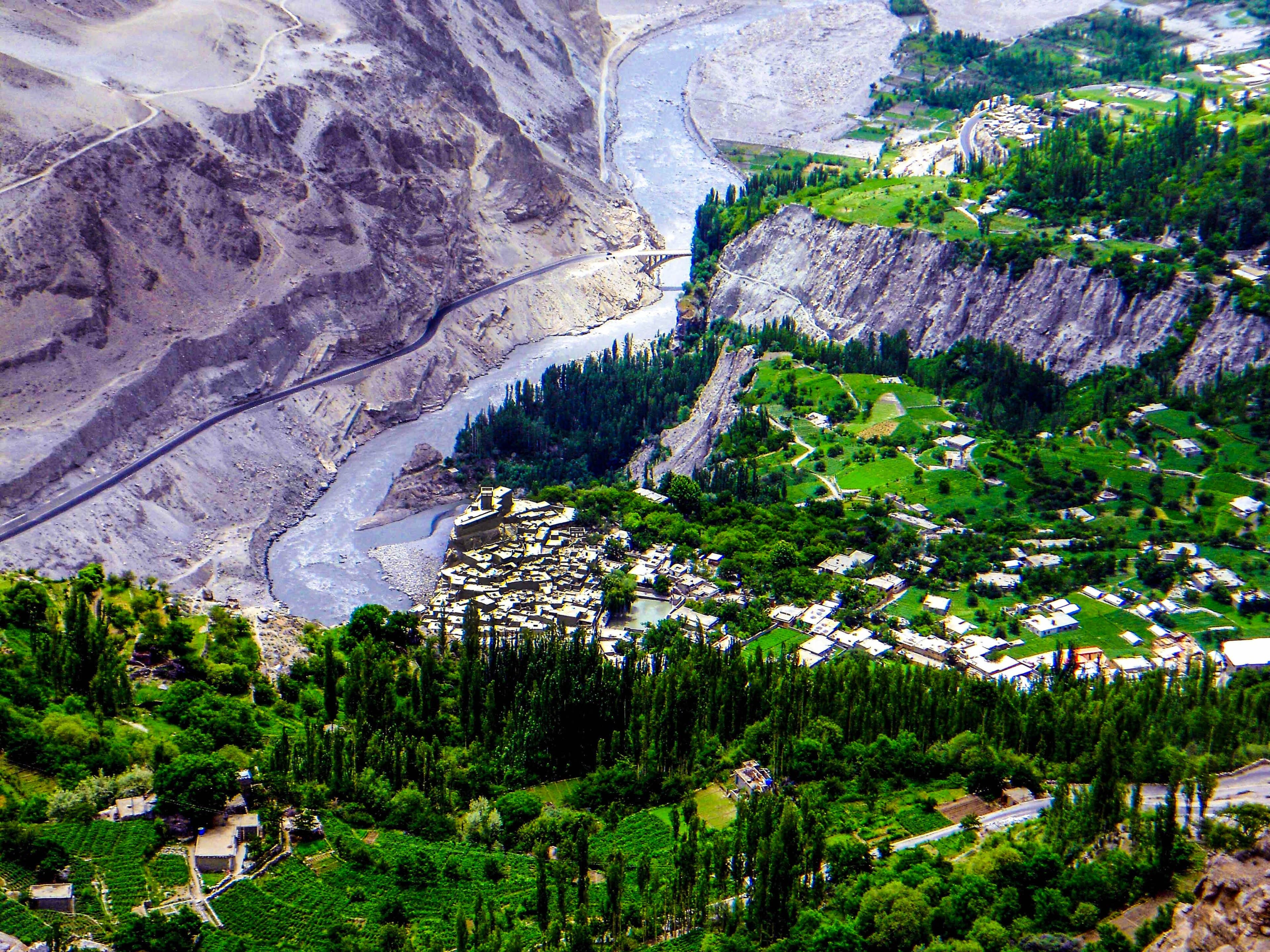
Central Hunza is the classic stage. The terraces below and around Karimabad layer blossom against Ultar Sar and Ladyfinger Peak, with Baltit Fort rising photogenically from the orchards — the lanes between Karimabad and Altit are made for slow walking in blossom season. Altit village's old quarter pairs 900-year-old stonework with flowering apricots in courtyard gardens.
Across the river, the Nagar side is the connoisseur's choice: villages like Ghulmet and the lanes toward Minapin put blossom directly beneath Rakaposhi's 7,788 m north face — arguably the single most dramatic blossom backdrop on earth. Duikar, above Karimabad, blooms later and adds the eagle's-eye view: at dawn from Eagle's Nest you look down on entire valleys flushed pink.
Don't overlook the drive itself: the Karakoram Highway between Gilgit and Hunza passes orchard village after orchard village, and some of the best photographs of the season happen at unplanned roadside stops. Ask your driver to take it slowly — everyone does in April.
Skardu's secret: Chunda Valley and Baltistan in bloom
Baltistan blooms first and, increasingly, most famously. Chunda Valley, a short drive from Skardu, has become Pakistan's celebrated blossom valley — a long ribbon of villages where apricot and cherry trees froth between stone walls and irrigation channels, with the Karakoram piled up behind. Late March to early April is its usual window.
Build a Baltistan blossom circuit from Skardu: Chunda one day; Shigar Valley the next, where blossom surrounds the 400-year-old Shigar Fort (sleep in the fort itself if you can); then Khaplu, whose amphitheatre of orchards beneath the Masherbrum range turns entirely pink-white at peak. The cold deserts at Sarfaranga and Katpana add a surreal bonus — blossom and sand dunes in one frame.
The ideal long itinerary chains both regions: fly to Skardu for the early bloom, then drive the spectacular Skardu–Gilgit road to Hunza as the wave climbs, catching peak twice in one trip. It's the blossom-season version of following the cherry front up Japan — except you'll often have a whole orchard to yourself.
Photography tips for blossom season
Work the edges of the day. Dawn light turns the snow peaks pink before the sun reaches the valley floor — be at Eagle's Nest or on the Nagar side early — while late afternoon backlights petals beautifully along the Karimabad lanes. Midday is for scouting, lunch and fort visits; the high-contrast light flattens blossom.
Composition advice from photographers who shoot the season every year: use a telephoto to compress blossom against the big faces (Rakaposhi from Ghulmet is the classic), get under the canopy and shoot up through flowers for abstract frames, and include human life — farmers ploughing, children walking to school — to give the spectacle scale and story. Spring weather is changeable, and a snow flurry over blossom is the jackpot frame, so don't hide from cloudy forecasts.
Etiquette matters: orchards are working farms and someone's livelihood, so ask before entering, never pull branches down for a shot, and ask permission before photographing people — especially women. An interested, respectful photographer is usually rewarded with an invitation to chai under the trees, which is the real prize.
Booking and planning: why early matters
Blossom season's fame has grown fast, and the best small hotels in Karimabad, the Shigar and Khaplu heritage forts and the better Skardu guesthouses now fill weeks ahead for late March–mid April — book accommodation and any internal flights one to two months out, more for the fort hotels.
Pack for two seasons at once: days can be a mild 15–20°C, but nights drop near freezing and high viewpoints like Duikar stay cold. Roads are in good shape, but note what's not yet open in early spring — Khunjerab may still be closed or freshly opened, and Deosai and Babusar are months away — so keep the itinerary orchard-focused. Our month-by-month guide covers the full seasonal picture, and the spring guide tracks blossom and reopening week by week.
Finally, hold your plans loosely and your camera tightly: blossom is weather, not a monument. The travellers who come home with the season's best memories are the ones who gave it a week of margin, followed local advice on which village was peaking, and let the bloom set the schedule.
Questions, answered
When is the cherry blossom season in Hunza?
Roughly late March to mid-April. Skardu and lower valleys begin in the last week of March, central Hunza around Karimabad usually peaks in the first half of April, and higher villages like Duikar bloom toward mid-to-late April. Exact dates shift up to a week year to year.
Where is the best place to see cherry blossom in Pakistan?
The Hunza terraces around Karimabad and Altit, the Nagar villages beneath Rakaposhi, and Chunda Valley near Skardu are the standout locations. Shigar and Khaplu in Baltistan add blossom around historic forts and palaces.
Is blossom season in Hunza crowded?
Far less than autumn or summer. It falls in shoulder season, so viewpoints are quiet — though the best small hotels and the fort heritage stays now book out weeks ahead, so reserve one to two months early.
Is the Khunjerab Pass open during cherry blossom season?
Often not, or only just — the pass usually opens around April and can be delayed by snow. Plan a blossom trip around the orchards, forts and valley sights, and treat a Khunjerab run as a bonus if conditions allow.